The February Stockport meeting saw Adam Benton give a presentation entitled Evolution in the Everyday: How the past 7 million years influences everything we do. Adam studies evolutionary anthropology at Liverpool University and runs a blog http://www.evoanth.net/ He is a long time attendee of Skeptics in the Pub but has never asked a question. This was his first public speaking engagement. For someone new to speaking in public he gave a very impressive performance.
To Adam evolution is everything. Living things change over time, animals reproduce with variation and, as some variants are better able to survive, more children are born to them and those variants become more common. Humans evolve because we’re animals too.
Working backwards in time Adam first considered the present day to 66 years ago (basline 1950). Just like all primates we have good vision (on the whole), the same basic body plan, opposable thumbs and nails instead of claws. Just like apes we have no tails but we do have some unique features: we walk upright, we’re (mostly) hairless, extensive tool users and super smart. Chimps, gorillas, orangutans and Gibbons all share a common ancestor with us.
50,000 years before the present our great (x1660) grandparents were what we now call cave dwellers. They were still primates, still apes and still fully human. They were bipedal, hairless, tool users and smart. They were able to plan and had specialised tools. They also mass produced tools implying ability to teach. They were flexible enough to use new materials and they used symbolism in the form of cave art. They were hunter-gatherers and built houses out of mammoths, presumably bones and skin. Caves were sacred places. Like us they met up with friends. It is thought that Venus figurines were a sort of secret handshake.
Nothing much was different in the life of Cro-Magnum man, except we had a lot of friends: Hobbit, Neanderthals, Denisovans, and Hominin-X. For the most part Neandertal man was similar to humans but shorter and squatter to preserve heat. They had old-fashioned skulls with brow ridges no forehead and no chin.
Everyone has their roots in Africa, but non-Africans have 3% Neanderthal DNA. In total 30% of Neanderthal DNA lives on in us. Some of these genes have aided survival giving rise to different shades of white skin and an immunity boost. Some have been harmful leading to Lupus, biliary cirrhosis, Crohn’s disease, smoking behaviour and type 2 diabetes.
A million years ago our great (x33,330) grandparents were categorised as Homo Erectus as represented by Narikotome boy. His skeleton is very modern but his skull isn’t. Homo erectus started with a 600ml brain, (cf, chimps 400 ml and Humans 1.3 litres) but was still capable of making tools such as the multipurpose hand axe. Their brains doubled in size before extinction. Living in groups requires brain power to remember relationships. Humans are good runners particularly over distance but can over heat in midday sun. The need to keep cool led to our being naked.
Two million years ago our great (x66,000) grandparents were living more like apes. Handy Man had a body adapted for life in the trees. He was smaller, had longer arms and more-curved fingers. His brain was only slightly bigger than a chimp. But he was still doing human stuff. Making tools, even simple flakes of rock, requires much skill and dexterity. These evolved into hand axes with much the same height/width ratio as a modern mobile phone. The hand evolved very early on. Some apes make tools and some modern apes have been trained to make flakes.
Three million years ago our great (x100,000) grandparents, as typified by Lucy, were well adapted for life in the trees with long arms and fingers but stared to spend a lot of time on the ground. Traits which evolved to help were a non-grasping toe and changed to the knees to bring the centre of gravity over the legs.
Paranthropus, a more heavily built species, was an actual grazer eating grass and bushes.
Five million years ago we come to the start of our story. Early hominins share many similarities with modern apes. They lived in trees, had grasping toes and long arms. There were several species living at this time. They were upright but in the trees, and needed arms for swinging, which is the reason we can raise ours. Climate change broke up the rainforests forcing them on the ground.
Adam had some very interesting replica skulls, from each of the periods discussed, which he handed round for us to examine.
He also discussed the problems of dealing with creationists who attempt to undermine evolution when they can. Many of them are racist, quoting bible accounts of Shem, Japheth and Ham to justify slavery and servitude.
Evolutionary psychology could be amazing but is too often WEIRD (Western Educated Industrialised, Rich, Democratic), and can be falsified by non-weird studies.
“You have been and are being evolved. There is grandeur in this view of life. . . “
“. . . from so simple a beginning endless forms most beautiful and most wonderful have been and are being evolved “
“We are risen apes not fallen angels”
In January Professor James Crossley gave a talk on Religion and the Bible in Contemporary Politics.
The 1960s were crucial to the understanding of religion in politics – British politics that is. It is then that Britain started to see a serious decline in church attendance which has carried through to the present day. But this decline was not accompanied by an equal decline in religious affiliation as nostalgia for a religious past persisted. At this time there were 4 distinct understandings of the bible:
1. The cultural bible – seen as something of a work of literature, part of the British heritage.
2. The liberal bible – seen as a source of democracy, tolerance and the rule of law.
3. The radical bible – seen as a source of socialism in the radical tradition (Tony Benn wrote a lot about the bible in this context at this time).
4. The neoliberal bible – used to highlight all that is good for right thinking people (examples given of some American bible in this vein were: The team bible for girls, The team bible for boys, The team bible for soldiers, etc.).
Margaret Thatcher was a conservative revolutionary who rediscovers her Methodism. She starts talking about ‘freedom’ and ‘individuality’ with reference to biblical texts and their applicability to the country in terms of entrepreneurialism, a minimal state, free will and such like. She sees the good in Judaism and how it supports the entrepreneur, how Jews support each other and the fact they are not reliant on the welfare state. Later on in her career though, she saw it as a failing that her policies had not made people more charitable, i.e. in the sense of giving, as opposed to judging others leniently.
Tony Blair inherits Thatcher’s template of individualism and non-reliance on the welfare state. Many of Blair’s speeches had subtle references to biblical learning that went unnoticed by Blair’s PR guru Alistair Campbell. Blair was unable to see religion as a bad thing: there were good Muslims and bad Muslims but only good religion. His speech at one Labour Party Conference had many allusions to the bible. The press didn’t pick up on them but it’s expected that many of his supporters would have done. Blair believed the origins of Islam show a picture of a good religion with democratic values.
David Cameron talks about the bible as though it’s everything we like; Michael Gove also. In 2012 the government sends a bible to every school in Britain probably knowing people wouldn’t read it, but liking the image it creates.
The main exponents of the Radical Bible were outside mainstream politics, people like Peter Tatchell, the Occupy movement, Russell Brand and through his influence, Ed Miliband (to a lesser extent).
Corbyn doesn’t reveal himself as a true Christian, but he did reference the good Samaritan in his leadership speech where he talked about ‘not walking by’. This reference is well worn by other politicians including Cameron, who also believes that ‘true Islam’ is peaceful, tolerant and non-violent.
American politics is different, there are over 200 million Christians, so religion is very important and affiliation to it is openly demonstrated. In English politics though there does seem to be a need for politicians to defer to a higher authority, however subtly, for the state to function.
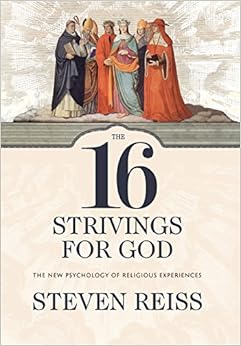
The Sixteen Strivings for God – The New Psychology of Religious Experiences by Steven Reiss
Humanists, and non-theists in general, are often puzzled by the ability of otherwise intelligent people to believe in nonsense. This new book by Steven Reiss offers powerful insights into why people adopt religious beliefs. Reiss identifies, from empirical research, sixteen basic human desires which can be fulfilled in differing degrees by various types of religious belief.
The list of sixteen basic desires contains nothing surprising (everything from the desire for food to the need for order) but what distinguishes his approach is the way in which it can be mapped onto religions. Earlier theories tend to concentrate on a small number of motivators (such as concern about death or need for community) but Reiss offers a comprehensive range of desires and argues convincingly that the majority of them can be satisfied by all the major world religions. Accordingly people adopt the type of belief that, in the context of their personal circumstances, meets the desires most strongly manifested in their characters. Indeed the contradictions in the major religions are necessary to accommodate a range of characters – people pick and mix the bits that best fit with their own strongest and weakest desires.
Less convincingly, Reiss claims that his position is ‘theologically neutral’ because knowing god would have to be related to human desire. This comes across as a rather weak attempt at apologetics -perhaps necessary for an American academic cornered by the power of his own insights. Clearly his theory does not disprove the existence of god but it does offer an explanation for religious behaviour without the need for supernatural complexity. As Occam would say, the simpler explanation is more likely to be correct.
Interestingly, based on Reiss’s own analysis, we can predict that religious believers will not be very bothered by Occam as long as their religion meets their own desires.
For this reviewer the most remarkable feature is that the list of desires does not contain anything that clearly relates to a desire for truth or evidence or the use of reason. The closest is ‘Curiosity’ but Reiss suggests that this can be satisfied by a study of theology. So the result is religious belief is motivated by basic desires and with little concern for truth. This is exactly what is observed – we have all noted that concern for truth is easily put aside amid a fog of irrational arguments and dodgy historical ‘facts’. Humanists, with a concern for evidence, truth and reason simply cannot fit into the religious part of the model.
This leaves us with a picture of religious belief as an essentially selfish phenomenon that satisfies whatever combination of basic desires is most dominant – even in cases where the dominant desires manifest in positive outcomes. And the outcomes do not have to be positive – the list of desires does not include Truth but it does include Status, Power and Vengeance. This is indeed a theory that fits the facts.
At the Stockport December meeting members brought with them a selection of books and films to introduce to the others. Considered or mentioned were:
- Dreams of Empire: Napoleon and the First World War 1792-1815 by Paul Fregosi. An account of a truly global conflict more than a hundred years before the 1914-18 war.
- Battle for Empire: The Very First World War1756-63 by Tom Pocock. An account of the Seven Years War which is considered by many as the very first global conflict.
- Flight to Afar by Alfred Andersch (1957) a novel which was made into a film in 1986. An encounter between a Pastor, protecting an icon; a communist; and a young Jewess attempting to escape Germany in the late 1930’s.
- Alone in Berlin by Geoff Wilkes. An ordinary man’s determination to defy the tyranny of Nazi rule, based on a Gestapo file.
- Annie Besant
- Catch Me Daddy A film about honour killings.
- Islam and the Future of Tolerance by Sam Harris and Maajid Nawaz. A dialogue between the two authors, considering: The roots of Extremism, the Scope of the Problem, the Power of Belief, The Betrayal of Liberalism, the Nature of Islam, and Finding the Way Forward.
- Among the Creationists: Dispatches from the Anti-evolutionist Front Line by Jason Rosenhouse. A personal memoir of a scientist’s attempt to come to grips with the evolutionist/creationist controversy by immersing himself in the culture of the anti-evolutionists.
- The God Argument: The Case Against Religion by A.C.Grayling (2013). Counters the arguments for the existence of god and puts forward humanism as an alternative to religion.
- The Complete Infidel’s Guide to Isis by Robert Spencer ( 2015). Reveals the inner workings of Islamic State – its recruitment program, financing its expansion, and the ideology driving its success.
- Hitch 22 – A Memoir By Christopher Hitchens. A citizen of both the United States and the United Kingdom, he has been a foreign correspondent in some very dangerous places. He was a fervent atheist, raise as a Christian by a Jewish mother.
- Blackham’s Best. Excerpts from H.J. Blackham selected by Barbara Smoker
- Death of a Prophet, The End of Muhammad’s Life and the Beginnings of Islam by Stephen J. Shoemaker. This raises Questions about the way Islamic origins should be studied and emphasises the potential of non-Islamic sources for reconstructing the history of formative Islam.
- In the Shadow of the Sword: The Battle for Global Empire and the End of the Ancient World by Tom Hollander. Another book on the origins of Islam
- The First Dynasty of Islam: The Umayyad Caliphate AD 661-750 by G. R. Hawting. An introductory survey of the period
- Confessions by St Augustine (trans. R.S.Pine-Coffin) Penguin Classics Edition. An account of how St. Augustine (354-430 CE) turned away from youthful ideas to become a staunch advocate of Christianity and one of its most influential thinkers.
Members brought an ample supply of food to share.
The November GMH meeting saw Kevin Malone give a talk
entitled Mark Twain Opera “Mysterious 44”.
Kevin began by explaining his upbringing in a religious Lutheran family. He happily went along with everything he was taught about God and his religion until at the age of 10 he came across a book by Mark Twain entitled Mysterious Stranger. Though originally written by Mark Twain it was unfinished at his death and completed posthumously by his editor. Kevin recalled that this book, “scared the life out of me”, and started him on a path of questioning his faith.
At age 11 there was a bus campaign in his home town with the message “God is Dead”. This added to his doubts and at this point he stopped going to church. He still battled with his belief in the divine though and managed to resolve his love of science and maths with theism by concluding that they were based on rules and that God therefore had created those rules.
Later in life as part of his musical studies he moved to Paris to study at the Paris Conservatoire. While there he decided to study the bible in fine detail, to the extent that he mapped out where and when the biblical events were supposed to have occurred. And in so doing, he confesses, he became an agnostic.
Kevin went on to talk about how the opera came about and how it was constructed. The book itself was set in Austria in 1490 but the events of 9/11 in 2001 were a key influence. In fact the opening of the opera features a piece involving a single cello and recordings of the New York air traffic controllers talking to flight crews in the air space at the time of the attacks on the twin towers. You can clearly hear one controller repeatedly trying unsuccessfully to obtain voice contact with flight ‘American 77’. The cello piece was appropriately entitled Requiem 77. Kevin talked about some of his other influences including the film the Unbelievers and Woody Allen films.
A key character in the book, hence the opera, is 44 - an angel with supernatural powers. Using a video extract from the opera, Kevin explained how in a scene reminiscent of an old testament story, 44 enables two human characters to magically create their own human specimens which rapidly evolve into less than perfect beings that do wicked things. Consequently the two characters beg 44 to destroy their creations. This whole scene really showed off Kevin’s musical skill as it interwove traditional operatic style musical dialogue with electronic incidental music and classical choral sequences.
Another key feature of the opera is Richard Dawkins’ voice which features at various points in the opera.
Richard was also one of the financial backers of the opera along with The Arts Council and the University. Kevin recounted how Dawkins was a willing contributor to the project and an able voice actor but was very hard to tie down time-wise to actually do the recordings.
Bringing the conversation back to the matter of religion, Kevin talked about how the credibility of an idea or a doctrine is enhanced by performance. Simply reading or stating something evokes one level of consciousness but singing it, as with church hymns, seeks to reinforce that idea, especially when promoted by institutions. Religions have, Kevin surmised, known this and exploited it for a long time.
You can see the latest version of the opera at the following locations in the New Year:
25 January - Manchester premiere at the Royal Northern College of Music, Studio Theatre, starting at 7pm. Tickets available from RNCM box office 0161 907 5555 and at www.tickets.rncm.ac.uk (they haven't been listed on their website yet).
27 January at the John Thaw Theatre, Martin Harris Centre for Music and Drama, Bridgeford St, Univ of Manchester. (Starting time is 7 or 7:30pm - awaiting Centre's decision).
29 January at Ordsall Hall, Salford during daytime for secondary school children performance.
1 February at Central Library, Manchester Performance Space 1 (TBC).
At the November Stockport meeting David Seddon spoke on Romanticism in his usual enthusiastic way. We heard how the word “Romanticism” came from Roman as did “Romance” as in the Romance Languages (French, Italian and Spanish).
The classical literature of the Romance stories written in Old French, Spanish and Italian were characterised by: a hero who fights evil, a lady for whom he is fighting, and a grateful Lord. One can think of our own Arthurian legends. Chaucer was deeply influenced by this literature.
In the late eighteenth and early nineteenth centuries, the Romantic Movement was born. The Brothers Schlegel in Germany were early exponents, responsible for the naming of the movement.
Before the romantic period there was a development in music reflected in the culture of the day. Under a strong hereditary system of Government, answerable to King and God, Bach, Handel and Haydn obeyed rules and wrote in a very disciplined way; at the same time producing wonderful music. Bach wrote music to order for the church. Handel’s patron and friend was George III for whom he wrote pieces like the Water Music and the Fireworks on request. Haydn invented the symphony and was commissioned by the King to write 106 of them.
There were rules in literature too. Alexander Pope thought that as well as rhyming and scansion we should be limited to big themes. John Milton also wrote very formal verse. Things begin to shift with Jean Jacques Rousseau who, not liking to be ruled by time, had no clocks. His political philosophy influenced the enlightenment in France.
The American War of Independence 1776-1781 heralded an era in which people were regarded as important for the first time: "We hold these truths to be self-evident, that all men are created equal, that they are endowed by their Creator with certain unalienable Rights, that among these are Life,
Liberty and the pursuit of Happiness".
The French Revolution followed in 1798 resulting in the execution of Louis XVI and his queen, Marie Antoinette. The French acquired a romantic hero in the form of the charismatic Napoleon Bonaparte, whilst the British romantic hero was Admiral Lord Nelson rather than the Duke of Wellington.
Musically Beethoven characterised the start of the romantic era. His freer form music now needed a conductor. He wanted to say something personal and wrote only nine symphonies. Later composers, such as Brahms, wrote only a few symphonies compared with the 106 of Haydn. Franz Schubert had a publisher rather than a patron making it easier to write the music he wanted.
In the year (1770) that Beethoven was born, William Wordsworth was born in Cockermouth. After being schooled in Hawkshead he went to Cambridge and in 1798 he went to Paris to witness the French Revolution in action. Disillusioned, he returned to London then to the Lake District with Samuel Taylor Coleridge. The two men wrote Lyrical Ballads, with a Few Other Poems first published in 1798 and generally considered to have marked the beginning of the English Romantic movement in literature.
Romanticism in art was aided by advances in paint technology that enabled Turner to produce his paintings without having to manufacture his paints every day.
In Literature Feminism began to make its mark. Jane Austen put heroines centre stage instead of heroes and highlighted women’s’ issues. The Bronte sisters also wrote from a woman’s point of view as did Mary Evans (George Eliot) and Mrs Gaskell. Mary Wollstonecraft had written A Vindication of the Rights of Men in response to Edmund Burke's conservative critique of the French Revolution, Reflections on the Revolution in France (1790); and she followed this with A Vindication of the Rights of Women (1792).
Unfortunately Feminists took a step backwards in the Victorian era.
In the area of Human rights, the first British slave to be emancipated was freed in 1772. The antislavery movement got under way in 1783 and the slave trade was abolished by Act of Parliament in 1807. The Slavery Abolition Act 1833 abolished slavery in most of the British Empire.
The meeting ended with a Q and A session.
October's Manchester meeting was a talk entitled Can Philosophy Provide Us with a Secular Account of the Idea of Evil by Dr Eve Garrard.
Eve started by questioning whether there is a secular concept of evil. A quick poll of the audience suggested a majority were against the idea. She however believed there was such a concept and went on to explain why. Initially she examined what the social sciences and history have to say about it and whether there is historical evidence of historians dismissing the philosophical argument in favour of it.
The Australian author Inga Clendinnen in her book “Reading the Holocaust” dismissed the concept of ‘evil’ as something ‘non explanatory’ and of no use in explaining why people do what they do. Another source described the concept of ‘evil’ as beyond human, implying that it is inhuman. There is however a recognised religious concept of evil. Eve then went on to outline three possible secular concepts of evil:
1. Anything adverse or unlikeable in human lives, e.g. natural disasters.
2. Immorality, e.g. genocide or malicious gossip.
3. Particularly horrifying actions.
The third she believed was the problematic one; the temple massacres of the 20th and 21st centuries and the holocaust cannot be classified simply as adverse, unlikeable or immoral.
She went on to talk about two real life examples of a belief in evil. The first related to the Harold Shipman murders and a report from the daughter of one of the victims who said “I tried and tried to understand and explain what he did but could only conclude he was evil”.
The second was a radio interview with two politicians commenting on the Military Wives Choir’s 2011 Christmas single. One of the politicians was from the far left and the other a centrist. The one from the far left described the choir as vicious, evil and vile. The centrist in response questioned what kind of person it took to call someone like that evil. The point being here that neither party needed an explanation or definition of evil to understand what the other meant. So it has an acceptable use even if we don’t have a theory of it.
Eve noted that Inga Clendinnen, while discounting the concept of ‘evil’ per se, does believe there is such a thing as an evil doer or monster which fits with the religious definitions of evil. A secular theory of ‘evil’ would need therefore to negate any metaphysical definitions. When we hear of some tortures or other evil acts that humans have committed on others we do regard them as monsters. So, Eve deduced, we need to understand ‘monsters’ to have a secular theory of evil. The problem is that there are too many theories of what would be described as evil acts. She outlined the following three:
1. An act which produces demonstrably bad outcomes.
2. An act in which one person takes pleasure from inflicting suffering on others.
3. An act in which the agent deliberately ignores its moral ramifications.
The first can be contradicted by the case of the voyeur who doesn’t contribute to the evil act. For the second, Eve cited the case of the Eichmann trial in which he was described (by Hannah Arendt who’d researched his personality in her book Eichmann in Jerusalem: A Report on the Banality of Evil) as being utterly banal. Meaning that he wasn’t taking pleasure but just carrying out orders.
As to the third example, Eve made the point that some people may do this but they believe they are doing the right thing. Some people, she said, believe the ‘right thing’ is following a set of moral rules like for example the 10 commandments; this is known as the ontological theory. The trouble is that there is no universal agreement about what is right, though there is a general understanding. And the same can be said for evil.
Eve concluded that there is no reason therefore to refrain from using the concept of evil. The question and answer session following the talk was lively; many saw the concept of evil as being an entirely religious one. A few expressed the opposite. Many philosophical questions were raised and Eve mainly responded with the appropriate philosophical answers, although in some cases she admitted that days, weeks or months would be required to give a complete response.